



AI Generated Image
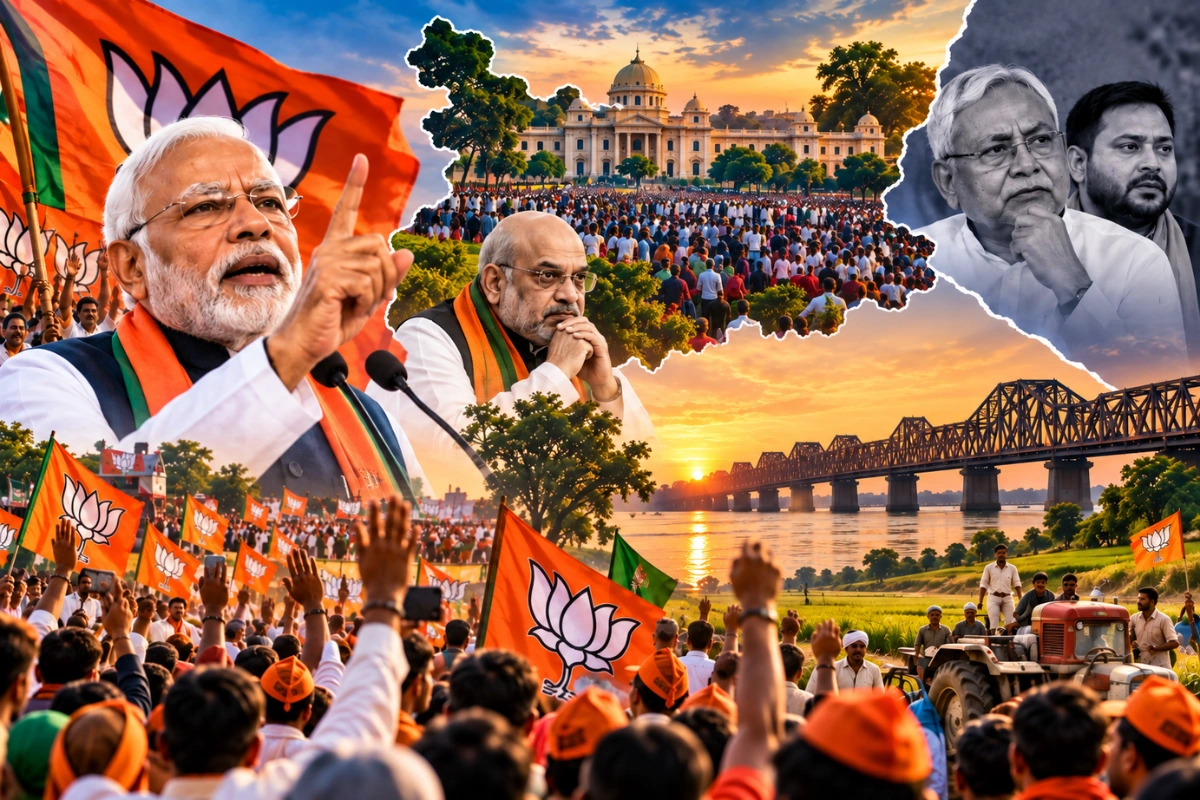
Bihar’s 243-seat Assembly has long forced national parties to think like coalition managers, not solo players. For the BJP, the central question in BJP Bihar politics is no longer whether it can influence the state, but whether it can eventually lead it without depending on a stronger regional partner.
Can the BJP Rule Bihar Without a Regional Big Brother?
The BJP can aspire to lead Bihar on its own terms, but it cannot ignore the state’s deeply regional political grammar. The NDA’s 2025 seat-sharing formula, with the BJP and JD(U) contesting 101 seats each, marked a shift from the old ‘elder brother’ model towards parity inside the alliance. That mattered because Bihar’s Assembly has 243 seats, with 122 needed for a majority.
The Alliance Balance Has Changed
For years, Nitish Kumar’s JD(U) gave the NDA a strong regional face, especially among caste groups and voters who viewed him through the lens of governance and social engineering. The BJP brought national leadership, organisation, Hindutva appeal, and campaign machinery. Together, the formula worked because each side filled the other’s gaps.
But parity in seat-sharing signalled that the BJP no longer saw itself as merely the junior partner in Bihar. Reports at the time described the equal 101-seat arrangement as a clear realignment within the ruling alliance.
The BJP Election Strategy Is Becoming More Local
A successful BJP election strategy in Bihar cannot rely only on national messaging. The party has to build booth-level strength, cultivate state leaders, manage caste arithmetic, and speak to local concerns around jobs, migration, welfare delivery, law and order, and rural aspirations.
Key priorities include:
- Expanding beyond urban and upper-caste comfort zones by deepening outreach among EBC, Dalit, OBC, and women voters.
- Developing a credible Bihar leadership bench so the party is not seen as dependent only on Delhi-driven campaigns.
- Managing allies without appearing subordinate, especially when partners such as JD(U), LJP(RV), HAM, and RLM bring distinct vote banks.
- Turning welfare into trust, because voters often reward parties that can connect benefits with visible local delivery.
Why Bihar’s Political Parties Still Matter
Bihar political parties are not interchangeable vehicles; they carry caste histories, regional identities, and emotional loyalties. The RJD remains associated with the Yadav-Muslim social base, JD(U) with Nitish Kumar’s governance legacy, and smaller allies with specific community influence. That is why BJP Bihar politics has to be coalition-aware even when the party’s ambition is expansion.
The 2025 result strengthened the NDA overall, with the alliance winning 202 seats and the BJP emerging as the largest contributor, closely followed by JD(U), according to PRS data. Yet the lesson is not that alliances are obsolete. It is that the BJP’s bargaining power has grown.
The Road From Partner to Principal Force
The BJP’s quest in Bihar is less about a dramatic break and more about gradual replacement of dependency with dominance. It needs allies today, but it wants a structure where allies supplement its strength rather than define it.
For readers following Bihar BJP news, the real story is this: Bihar may be moving from regional-party-led coalitions to a phase where the BJP tries to become the central pole. Whether it succeeds will depend on local leadership, caste accommodation, and its ability to make national appeal feel authentically Bihari.
Also Read: The Great Mandal vs Kamandal Clash: The Day Bihar Arrested Advani’s Rath
To read more such news, download Bharat Express news apps