




AI Generated Image
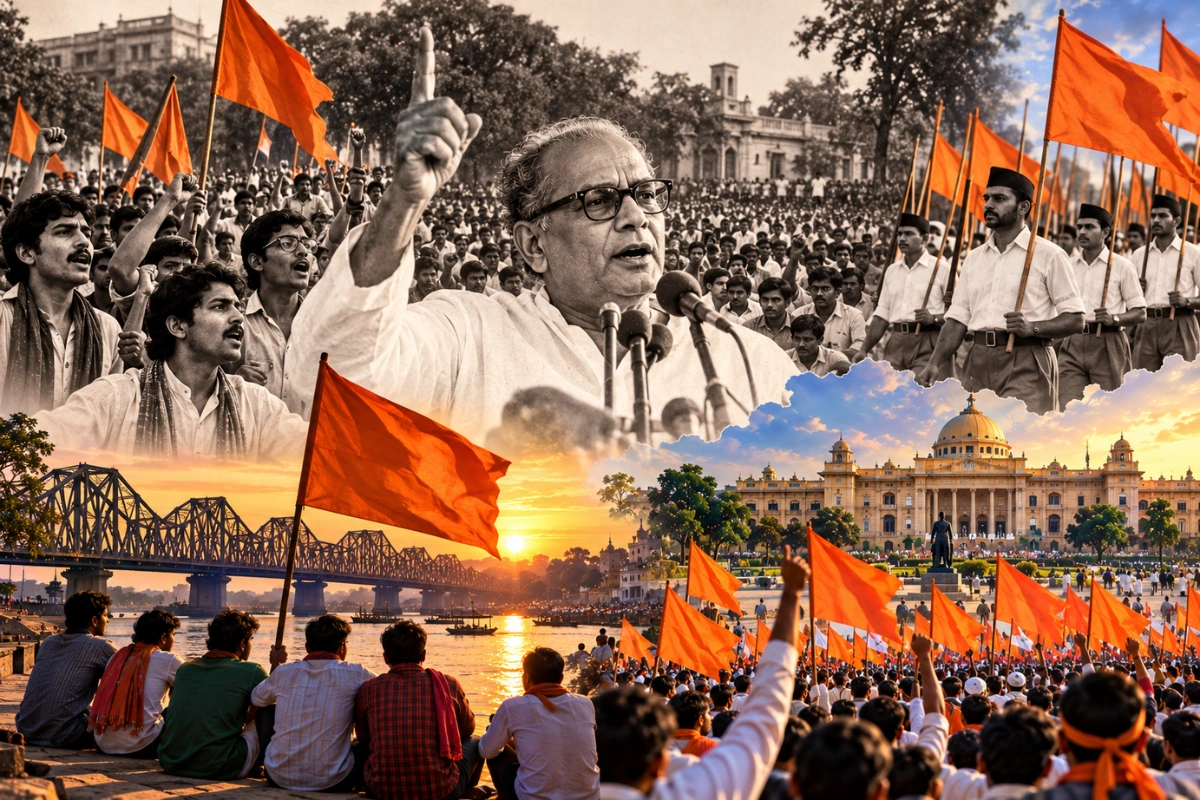
The political story of the saffron flag in Bihar is not only about present-day party imagery. Its roots run through the upheaval of the 1974–75 JP movement, when Jayaprakash Narayan’s socialist call for ‘total revolution’ brought students, anti-Congress parties and disciplined cadre networks into the same protest space. That convergence helps explain why searches for the saffron flag in Bihar often lead back to a period remembered publicly as socialist, but organisationally shaped by many currents.
Why Did Saffron Symbolism Find Space in JP’s Bihar?
Saffron symbolism found space because the Bihar movement was broad, urgent and anti-establishment, not ideologically uniform. Student anger against corruption and misrule expanded into a mass agitation, and groups linked to the Jana Sangh, RSS and ABVP operated alongside socialists and other opposition forces. The result was a political environment in which the language of democratic resistance could coexist with the quiet spread of Hindu nationalist symbols and networks.
JP’s appeal mattered because he gave moral legitimacy to a movement larger than any one party. In that crowded field, organisational discipline became as important as slogans. Cadres that could mobilise, hold meetings, distribute messages and sustain protest activity gained influence even when the public face of the movement remained socialist and anti-authoritarian.
What the Record Shows
The available accounts point to a layered, sometimes contested history rather than a single takeover narrative.
- The Agitation Began With Students: The Bihar movement grew from student protests in 1974 before JP took charge of the wider campaign.
- ABVP Claimed Involvement: The organisation’s own timeline describes participation in the Bihar student agitation and later mobilisation during 1974–75.
- Jana Sangh and RSS-Linked Figures Were Visible: Accounts of the movement refer to Nanaji Deshmukh and other organisers playing important roles in the anti-Emergency network.
- The Coalition Was Ideologically Mixed: Socialists, student leaders, opposition parties and Hindu nationalist groups all found room under the anti-Congress umbrella.
The Saffron Flag Carried More Than One Message
The saffron flag’s meaning depends on who is using it and in what setting. In Hindu traditions, saffron is associated with renunciation, sacrifice and sacred duty; in modern politics, it has also become closely tied to Hindutva organisations and public assertions of Hindu identity. The same colour can therefore signal spiritual symbolism to one audience and political mobilisation to another.
That ambiguity was useful in Bihar’s turbulent politics. A saffron flag did not always need to announce itself as a party banner to build recognition. It could appear through processions, shakhas, student mobilisation and local networks, gradually normalising a visual vocabulary that later became far more explicit in electoral politics.
Why It Matters Now
Bihar’s JP legacy is often claimed by leaders across ideological lines, from socialists to the BJP’s wider political family. The history of saffron symbolism complicates that inheritance. It shows that movements remembered for one dominant idea can also become vehicles for other forces waiting for social acceptance, organisational reach and the right political opening.
The saffron flag’s rise in Bihar was not sudden. It grew in the shadow of socialism, through alliances, street politics and the long afterlife of the JP movement.
Also Read: Tejashwi’s Gamble: Can The Heir Of Social Justice Turn Bihar’s Youth Into A New Empire?
To read more such news, download Bharat Express news apps