



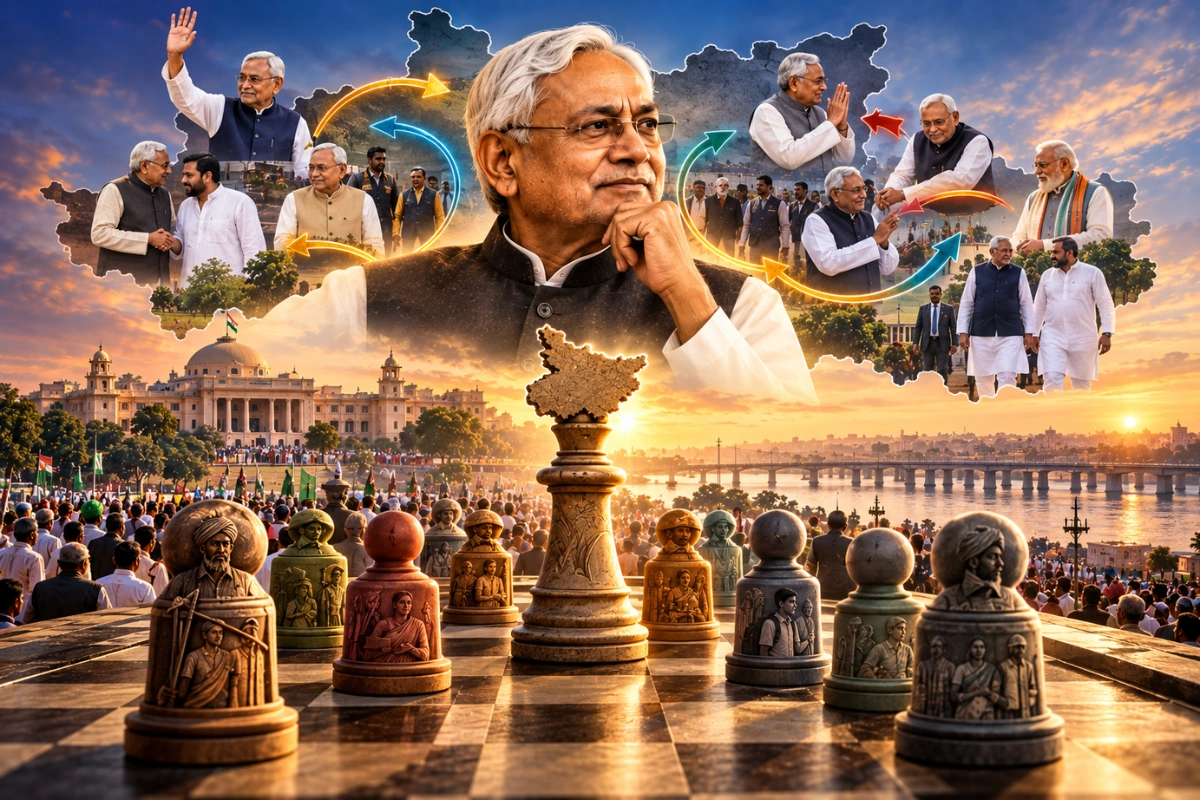
AI Generated Image
Nitish Kumar’s two-decade hold over Bihar’s top office has formally given way to a new phase, but the political method he perfected remains central to any reading of Bihar politics. After taking the oath as a Rajya Sabha member on April 10, 2026, Kumar stepped down as Chief Minister, and BJP leader Samrat Choudhary took the oath as Bihar Chief Minister on April 15, 2026. The transition closes one chapter of Kumar’s power story while keeping alive the debate over his survival tactics, alliance pivots, and leadership code.
What Was Nitish Kumar’s Survival Code?
Nitish Kumar’s survival code was built on controlled reinvention: never letting ideology, alliance arithmetic, or personal setbacks permanently lock him out of power. His method blended social coalition management, timing, administrative branding, and a willingness to change partners when the balance of power shifted. Critics called it opportunism; supporters described it as practical coalition management in a fragmented state where no single force could easily dominate for long.
That code explains why Kumar remained a decisive figure even when his party, Janata Dal (United), was no longer the largest player in the alliance table. His survival techniques were not only about winning elections; they were about remaining indispensable after elections. In Bihar’s coalition era, that often mattered as much as raw seat count.
A Career Shaped by Alliances, Exits, and Returns
Kumar first became Chief Minister in 2000 for a brief seven-day term before returning with a stable NDA government in November 2005. From there, he built a governance image around roads, law and order, welfare outreach, and the promise of moving Bihar beyond the disorder associated with the previous era. That administrative branding gave him political capital that he repeatedly spent during later alliance shifts.
The most visible feature of the Nitish Kumar survival code was his ability to move between rival camps without fully losing relevance. He broke with the BJP-led NDA in 2013 after Narendra Modi emerged as the BJP’s Prime Ministerial face, resigned in 2014 after JD(U)’s Lok Sabha setback, returned to power with the RJD-Congress alliance in 2015, moved back to the NDA in 2017, shifted again to the Mahagathbandhan in 2022, and rejoined the NDA in January 2024. Each move carried political cost, but each also reset his bargaining position.
The Five Survival Tactics That Defined His Politics
- Keep Every Door Half-Open: Kumar rarely treated political separation as permanent. Even after sharp ruptures, he preserved enough room for a return when conditions changed.
- Make Governance the Personal Brand: Roads, order, welfare schemes, and administrative control became the language through which he justified power beyond party labels.
- Occupy the Middle Ground: In a state shaped by caste blocs, regional loyalties, and national party pressure, Kumar positioned himself as a balancing figure rather than a single-camp warrior.
- Move Before Being Trapped: His major alliance exits often came before he was fully cornered, allowing him to frame the move as strategy rather than defeat.
- Accept Smaller Numbers, Demand Larger Relevance: Even when JD(U)’s strength declined, Kumar remained useful to larger allies because he carried experience, a social base, and the credibility of incumbency.
These survival tactics made him unusually durable. They also made him vulnerable to the charge that his politics prized continuity of office over ideological consistency.
The 2025 Mandate and the 2026 Transition Changed the Equation
The 2025 Bihar Assembly election strengthened the NDA and set the stage for a new internal balance. Reports at the time described the NDA as securing a decisive victory, with Kumar returning for another term before the eventual leadership transition in 2026. By April 2026, BJP’s Samrat Choudhary had taken over as Chief Minister, marking a major shift in Bihar’s ruling structure and the BJP’s role in the state.
For Kumar, the move to the Rajya Sabha did not erase his legacy; it reframed it. The man long described as Bihar’s most durable coalition player left the Chief Minister’s chair after a run that began in earnest in 2005 and passed through repeated crises, resignations, and comebacks. The leadership code that kept him afloat now becomes a template others may study, copy, or reject.
Why It Still Matters for Bihar Politics
Kumar’s story matters because Bihar politics remains shaped by the same forces he navigated: caste arithmetic, alliance management, welfare promises, development claims, and national party ambitions. His exit from the Chief Minister’s office does not end those pressures. It simply transfers them to a new leadership arrangement under the NDA.
The ‘Chanakya’ label attached to Kumar comes from this long record of calculation, patience, and tactical retreat. Yet the untold story is not just cleverness; it is the discipline of staying relevant in a state where mandates are layered, alliances are unstable, and public memory is both forgiving and sharp. His leadership code delivered survival, but it also leaves Bihar with a bigger question: whether the next era can convert political management into durable governance gains.
For now, Nitish Kumar’s 20-year survival code stands as one of modern Indian politics’ clearest case studies in coalition resilience. It shows how survival techniques can extend a career, reshape a state’s power map, and redefine what leadership means when authority depends less on certainty than on constant negotiation.
Also Read: Engineered Power: How An Electrical Engineer From Bakhtiarpur Fixed Bihar’s Political Grid
To read more such news, download Bharat Express news apps