



AI Generated Image
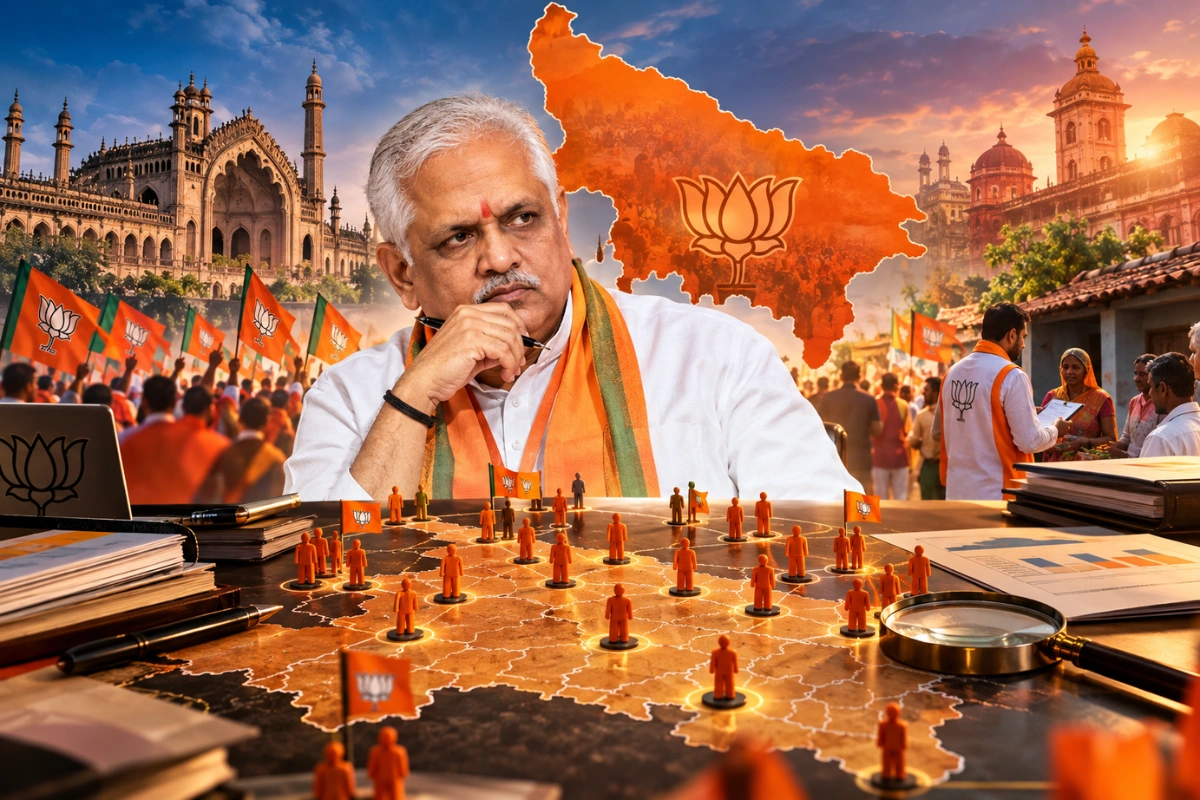
The BJP’s Uttar Pradesh 2027 preparations are moving from broad political messaging to a tighter organisational drill, with BL Santhosh emerging as the central figure for booth strategy and cadre mobilisation. Santhosh, the BJP’s National General Secretary (Organisation), was scheduled for a two-day Uttar Pradesh tour this month, including high-level meetings in Lucknow to review the party’s 2027 election strategy before moving to Kanpur for regional-level discussions.
The developing BJP UP 2027 game plan places renewed emphasis on aggressive grassroots mobilisation, strict organisational discipline, and meticulous micro-booth management. The push also reflects the party’s attempt to connect governance delivery with election readiness, ensuring that the organisation and the state government machinery work in tandem from the top leadership down to booth-level workers.
What Is the BJP’s Main Focus for Uttar Pradesh 2027?
The BJP’s main focus for the Uttar Pradesh elections is to convert its large organisational network into a sustained campaign machine that works booth by booth, not just rally by rally. Reports from Lucknow indicate that the party wants local leaders, elected representatives, district office-bearers, frontal organisations, and booth teams to operate with sharper coordination as the state moves towards the 2027 Assembly contest.
This is why Santhosh’s intervention is being seen as significant. While political messaging and leadership visits may set the campaign tone, the BJP’s election machinery depends heavily on disciplined implementation: updated booth committees, active workers, issue-based outreach, and timely feedback from the ground. In practical terms, the BJP election strategy appears to be built around constant local activity rather than a campaign that peaks only near polling.
Santhosh to Steer Organisational Review in Lucknow
Santhosh’s two-day tour was planned with Lucknow as the first major stop, where he was expected to chair a high-level core committee meeting focused on the 2027 Assembly election roadmap, the current political situation, and future organisational programmes. The schedule also included interaction with state office-bearers to gather ground-level feedback before a second-day review in Kanpur with regional functionaries at division and mandal levels.
As BJP’s National General Secretary (Organisation), Santhosh’s role is distinct from that of a public campaigner. He will likely assess the party structure, booth-level cadre activity, and uniform implementation of organisational instructions across regions. That makes his Lucknow meetings important for both political planning and internal discipline.
Party sources cited in recent reports said Santhosh is also likely to focus on coordination between the organisation and the Uttar Pradesh government led by Chief Minister Yogi Adityanath. This coordination is central to the BJP’s winning strategy because welfare schemes, governance claims, and local campaign messages have to travel through the same grassroots network that manages voter contact.
Key Elements of the Emerging Campaign Plan
The BJP’s preparations point to a layered campaign model. Instead of relying only on central rallies, the party appears to be working on a structure where each level of the organisation has measurable responsibilities.
Key focus areas include:
- Aggressive grassroots mobilisation: Activating workers in villages, wards, mandals, and urban clusters so the campaign remains visible and continuous.
- Strict organisational discipline: Reducing internal friction, ensuring leaders follow assigned roles, and keeping public messaging aligned across the state.
- Meticulous micro-booth management: Strengthening booth committees, panna pramukh networks, shakti kendras, and direct voter contact systems.
- Governance-to-ground linkage: Reviewing whether welfare schemes and government initiatives are reaching beneficiaries and being communicated effectively.
- Cadre feedback loops: Using reports from MPs, MLAs, district leaders, and booth workers to adjust local strategy before the campaign enters its final phase.
This approach also shows why the party is treating booth-level work as more than a logistical exercise. In a state with 403 Assembly seats, small shifts in caste equations, local grievances, candidate selection, or beneficiary outreach can affect constituency-level outcomes. That is why current UP election analysis inside and outside the party is likely to focus on whether the BJP can maintain organisational cohesion while countering a more active opposition.
Vinod Tawde Anchors Central Strategy in Lucknow
Vinod Tawde, the newly appointed BJP state in-charge for Uttar Pradesh, has already begun anchoring central strategists in Lucknow. His first visit after the appointment included meetings with Chief Minister Yogi Adityanath and senior state leaders, as well as separate organisational discussions at the BJP state headquarters.
Tawde’s role will likely bridge Delhi and Lucknow by coordinating the central leadership, state unit, cadre network, and alliance partners. Organisational expansion, election preparation, candidate-related inputs, and communication between national and state leadership also form part of his role.
In the emerging division of responsibilities, Tawde appears to be shaping the political roadmap while Santhosh sharpens the organisational machinery needed to implement it. That pairing matters because the BJP’s 2027 campaign will require both: a clear statewide narrative and a booth-level system capable of converting that narrative into voter contact.
Governance Review Becomes Part of Election Preparation
Santhosh will likely meet Chief Minister Yogi Adityanath, state BJP chief Pankaj Choudhary, and state general secretary (Organisation) Dhrampal Singh to review governance and ground-level implementation, including welfare scheme delivery. Recent meetings in Lucknow have already brought together Yogi Adityanath, Tawde, Pankaj Choudhary, Dhrampal Singh, and other senior leaders to discuss organisation, governance, and election-related issues.
The purpose is not only to assess political messaging but to test whether government schemes are translating into local goodwill. For the BJP, this means checking beneficiary reach, clear communication of government programmes, and quick escalation of complaints from the ground. In a long campaign, that kind of synergy between the party organisation and government machinery can become as important as rallies or slogans.
Why the 2027 Contest Carries Wider Political Weight
Uttar Pradesh remains India’s largest Assembly battleground, with the 2027 election carrying significance beyond the state. The BJP is seeking another term in a state it won in 2017 and retained in 2022, while opposition parties will likely challenge it through caste coalitions, local issues, and anti-incumbency narratives.
For the BJP, the current plan reflects managing incumbency through organisation rather than relying solely on leadership appeal. That is why the party’s senior strategists are concentrating on cadre energy, booth preparedness, government-party coordination, and disciplined messaging months before the final campaign. The shape of the BJP UP 2027 game plan is therefore becoming clearer: keep Lucknow aligned with Delhi, keep the government linked to the booth, and keep workers active long before polling begins.
Also Read: De-Weaponizing Technology: India’s Stand Against Digital Imperialism
To read more such news, download Bharat Express news apps